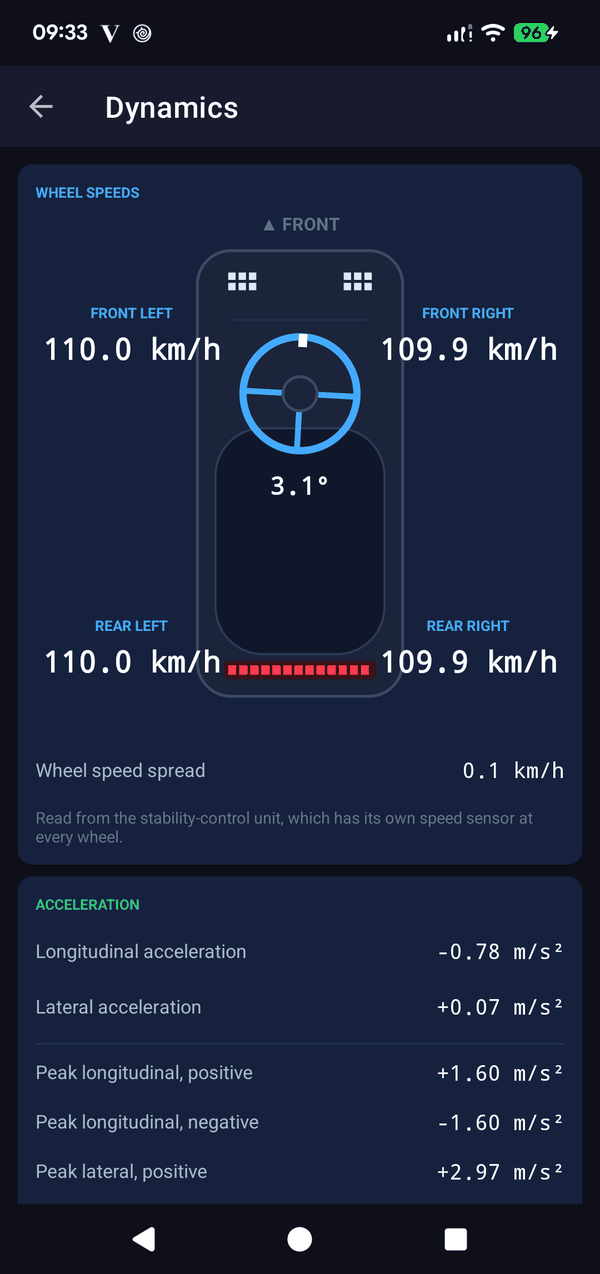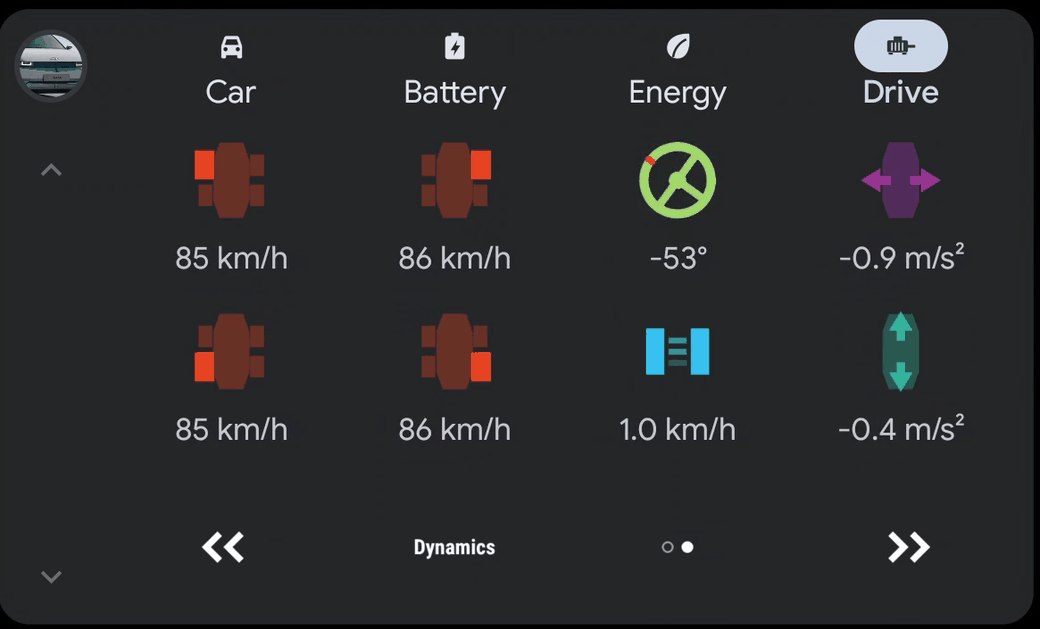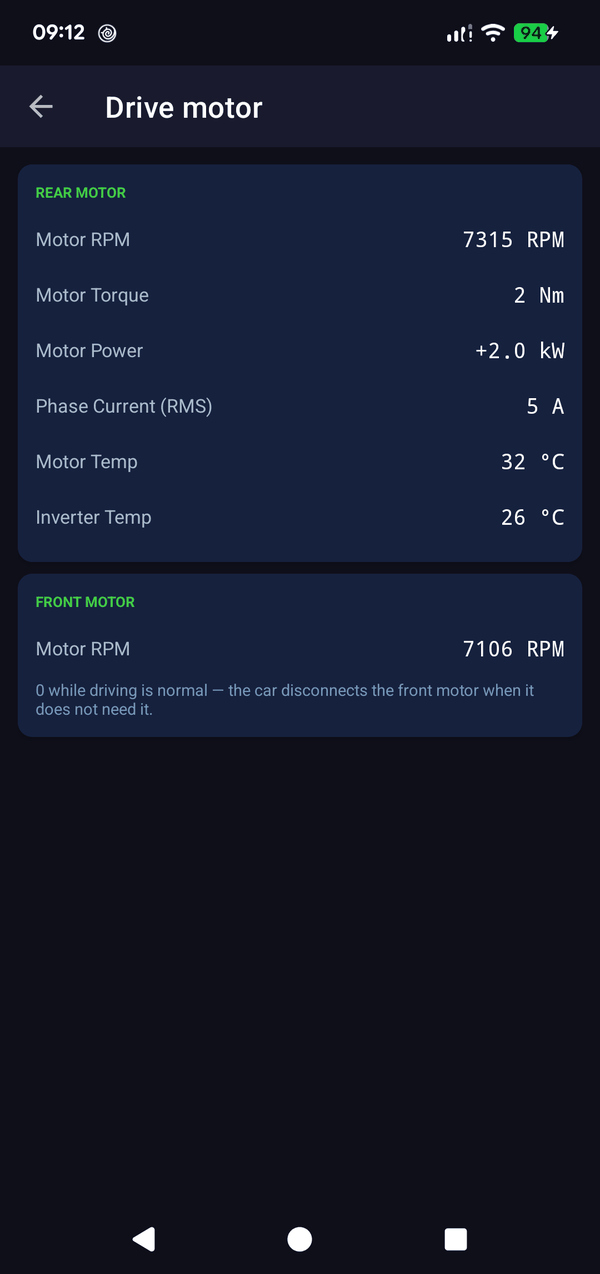
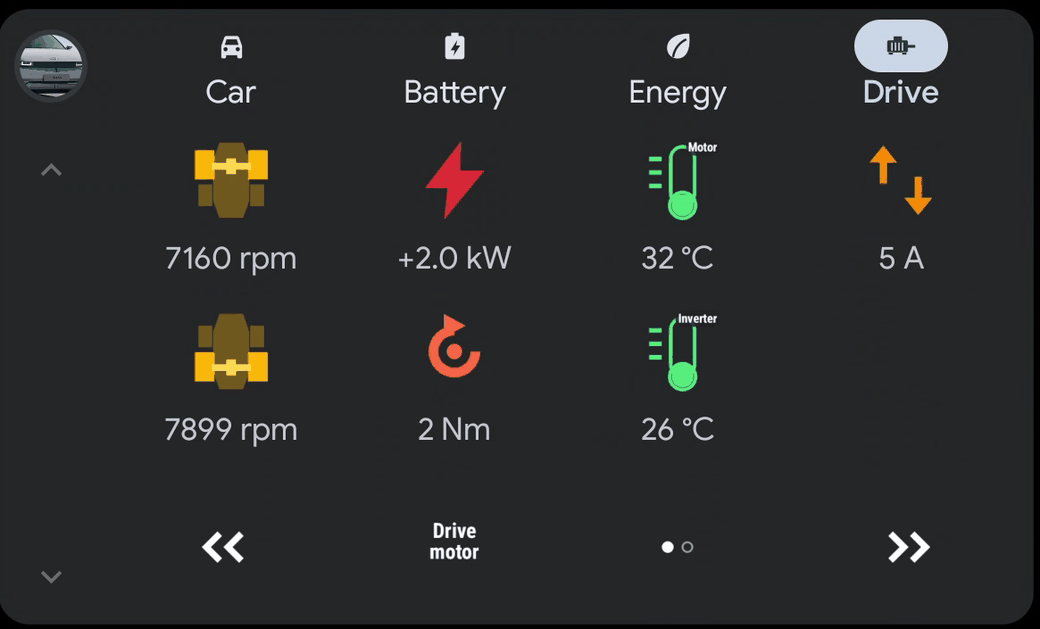
What turns the wheels, and what the wheels are doing.
What turns the wheels. The rear motor reports its speed in rpm, the torque it is producing and the power that works out to, plus the phase current its inverter is pushing through the windings.
Two temperatures matter here, and they are not the same thing: the motor itself, and the inverter that feeds it. The inverter also warms up while DC charging at a 400 V post, for a quite different reason — an E-GMP pack runs at 800 V, so the car presses that same inverter into service as a step-up converter, using the motor windings as its coil. At an 800 V post nothing needs converting and it stays cool.
On an all-wheel-drive car the front motor reports its speed as well. Zero while driving is normal: the car disconnects the front motor when it does not need it, which is part of why a rear-biased EV is as efficient as it is.
Your car is drawn from above, with the speed of each individual wheel at its own corner and a steering wheel in the middle showing the steering angle. These numbers do not come from the speedometer: they are read from the stability-control unit, which has its own speed sensor at every wheel.
Why four speeds instead of one: they should agree. The wheel speed spread underneath is the gap between the fastest and the slowest wheel, and that single number is where slip shows up — a wheel spinning up on a wet roundabout, or one dragging under braking. A small spread through a corner is normal; a large one on a straight road is not.
Below that, live longitudinal and lateral acceleration — how hard you are accelerating or braking, and how hard you are cornering. The app also keeps the peaks it has seen, so you can pull over and look at what the car actually did rather than trying to read the numbers while they happen.